
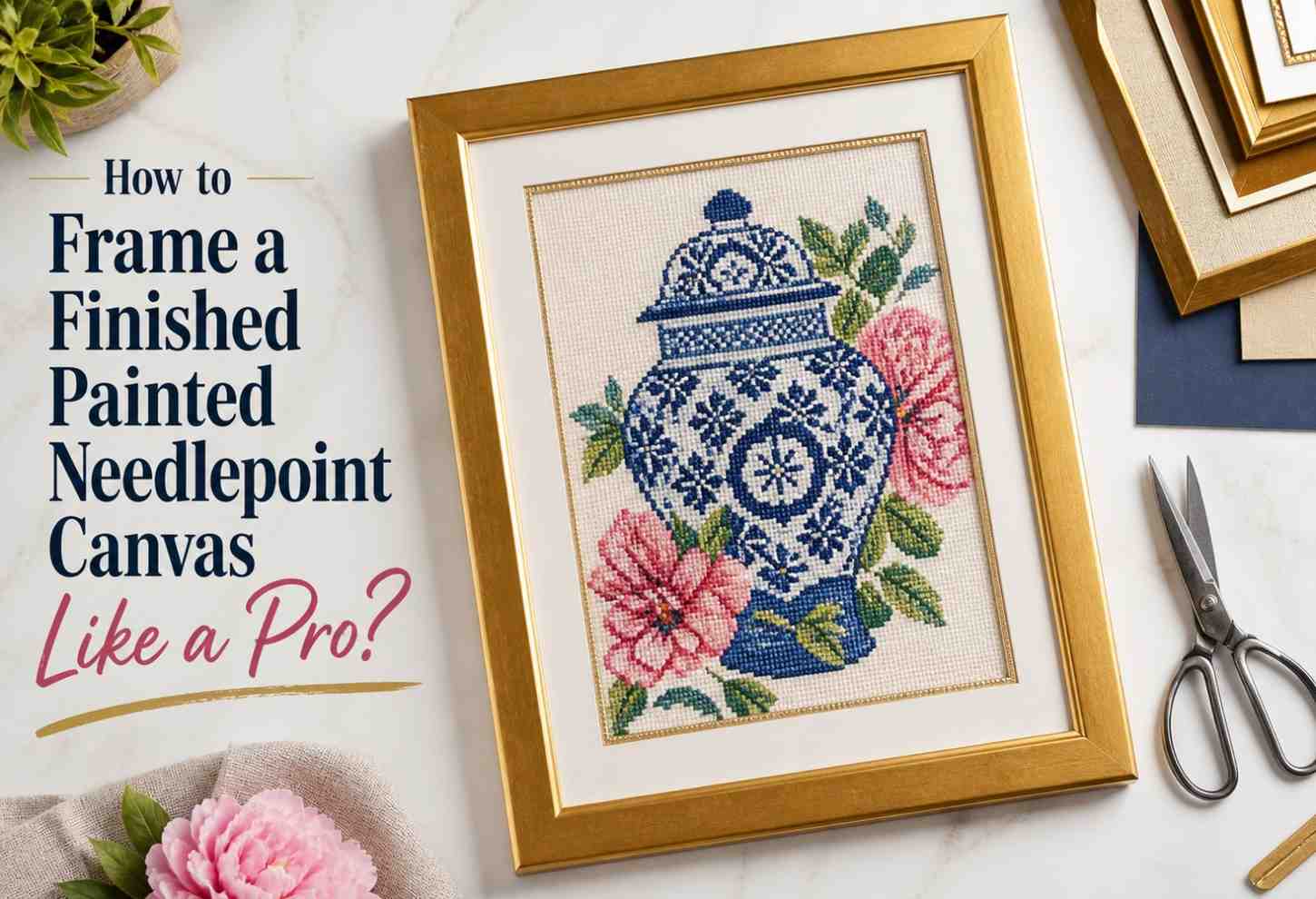
If you've just finished stitching a painted needlepoint canvas, first of all, congratulations. Completing a needlepoint project takes real patience, focus, and love for the craft. Whether it took you a few weeks or several months, you've created something worth showing off. And the best way to do that is by framing it properly.
Framing a finished needlepoint canvas isn't just about making it look pretty on the wall. Done right, it protects your work, keeps it taut, and gives it the polished, gallery-worthy look it deserves. Done wrong, and you could end up with a warped, wrinkled, or damaged piece that's hard to fix later.
This guide is going to walk you through the whole process, from blocking and stretching to choosing the right frame, so your finished canvas looks its absolute best for years to come.
Why Framing a Needlepoint Canvas the Right Way Actually Matters
A painted needlepoint canvas is not the same as a regular piece of fabric or a printed poster. It's a hand-stitched work of art that often has texture, depth, and sometimes sentimental value. Many stitchers work on pieces designed by well-known artists and canvas painters, like Kirk Bradley Needlepoint designs, which are widely loved for their bold colors and detailed motifs, or they shop from specialty retailers like Emily's Stitchery, where curated, hand-painted canvases are a big part of the collection.
Because hand-painted needlepoint canvases carry that kind of care and craftsmanship, the framing process needs to match that level of attention. Skipping steps or using the wrong materials can ruin months of work. So before you pick up a hammer, let's start from the beginning.
Block Your Canvas Before Anything Else
Blocking is the process of reshaping your finished needlepoint canvas back to its original, even dimensions. When you stitch, especially with continental or tent stitches, the canvas naturally pulls and distorts. Blocking fixes that.
To block your canvas, you'll need a clean foam board or blocking board, rust-proof T-pins, and cold water. Lightly dampen the back of your stitched canvas using a spray bottle or a damp cloth; don't soak it. Then, pin it face-down onto your blocking board, stretching it gently into a square or rectangular shape as you go. Start from the center of each side and work outward. Leave it pinned until it's completely dry, which usually takes 24 to 48 hours, depending on the humidity in your space.
If your canvas is significantly warped, which can happen with larger or more densely stitched pieces, you may need to repeat the blocking process once or twice. It's worth the time. A well-blocked canvas frames beautifully. A skipped blocking step will haunt you every time you look at the finished frame on your wall.
Stretch and Mount the Canvas on a Backing Board
Once your canvas is blocked and fully dry, the next step is mounting it onto a rigid backing board. This is what holds the canvas flat inside the frame and gives the whole piece that clean, professional look.
Use a piece of acid-free foam core board or archival-quality mounting board cut to the size of your stitched area. Acid-free materials are important because they prevent yellowing and degradation over time, something that matters a lot when you've invested in a quality painted needlepoint canvas from a designer collection or a trusted shop like Emily's Stitchery.
Place your canvas face down on a clean surface, center the backing board on top of it, and fold the canvas edges over the board. Use a lacing technique, which involves threading strong thread or twine back and forth across the back of the board, pulling the canvas tight as you go, to secure it. This method is preferred by professional framers because it keeps even tension across the entire surface and doesn't use adhesive that could damage the fabric. Alternatively, you can use stainless steel staples on the back edge of the board, but lacing gives a cleaner, longer-lasting result.
Choose the Right Frame for Your Canvas
Here's where a lot of people get stuck. There are so many frame styles out there, and it can be hard to know what works well for needlepoint specifically.
The most important thing is depth. Because a stitched canvas has a physical texture, you need a frame with enough depth, called the rabbet depth, to accommodate it without crushing the stitches. Look for frames with at least a 3/8 inch to 1/2 inch rabbet. If you're working with a canvas that has raised stitching or dimensional elements, you may need even more depth.
In terms of style, that's really up to you and your home. Traditional wooden frames in gold, walnut, or antique finishes tend to complement classic or floral needlepoint canvas designs well. More contemporary or geometric designs, like some of the modern offerings you'd find in Kirk Bradley Needlepoint collections or on sites like Emily's Stitchery, can look great in simple black or natural wood frames that don't compete with the design.
As for glass, this is a point of real debate among needlepoint enthusiasts. Many framers and stitchers recommend skipping the glass entirely because the texture of the needlepoint is part of its charm, and glass can flatten that visual depth. If you do want glass for protection, especially if the canvas will hang in a high-traffic area, choose UV-protective, non-glare glass to keep the colors from fading and reduce reflections.
Assembly and Final Touches
With your mounted canvas and frame ready, assembly is the straightforward part. Place the mounted canvas inside the frame, making sure it sits evenly. Secure the back with frame points or small nails using a point driver tool, or have your local frame shop do this step if you're not comfortable. Add a dust cover, a piece of brown kraft paper taped to the back of the frame, to keep dust and insects out.
Attach D-ring hangers on the back, about one-third of the way down from the top on each side, and run picture wire between them. Make sure the wire has enough slack to hang evenly but not so much that the frame tilts forward. If your needlepoint canvas is particularly large or heavy, use two wall anchors instead of one to distribute the weight properly.
Should You Use a Professional Framer?
This is a fair question, and the honest answer is: it depends. If your canvas is large, irregularly shaped, or has significant sentimental or monetary value, working with a professional framer who has experience with needlepoint or textile art is absolutely worth the cost. They'll have the right tools, materials, and expertise to handle it without risk.
If you're working with a smaller canvas and you're comfortable with basic DIY projects, framing it yourself can be a satisfying extension of the whole creative process. Either way, using archival materials and taking your time will make a real difference in the end result.
In 2026, custom framing costs in the US typically range from $80 to $300 or more, depending on frame size, materials, and the framer's location. Many online custom framing services now also cater specifically to textile and needlepoint work, offering measured-to-fit frames and archival mounting kits shipped directly to your door.
The Final Word
Framing a finished, needlepoint canvas is genuinely one of the most rewarding parts of the whole stitching journey. You've put in the hours, you've chosen beautiful thread, and you've brought a hand-painted design to life stitch by stitch. Framing it properly is simply giving that work the respect it deserves.
Take your time with blocking, be thoughtful about your materials, and don't rush the final assembly. Whether you're framing a classic Kirk Bradley Needlepoint design or a one-of-a-kind canvas you found browsing Emily's Stitchery, the result, a beautifully framed, professionally painted needlepoint canvas hanging on your wall, is absolutely worth every step.
FAQs
Do I have to block my canvas before framing it?
Yes, blocking is strongly recommended before framing any painted needlepoint canvas. Stitching naturally distorts the canvas mesh, and blocking reshapes it back to its proper dimensions. Trying to frame a warped canvas without blocking first will result in uneven tension, visible puckering, and a finished piece that looks off. It's an extra step, but it makes a significant difference.
Can I use regular picture frames for needlepoint, or do I need a special frame?
You can use regular picture frames as long as they have enough rabbet depth to accommodate the thickness of your stitched canvas without pressing down on the stitches. Standard photo frames are often too shallow. Look for frames marketed for canvas paintings or textiles, or shop at a custom framer who can account for the depth of your specific piece. Emily's Stitchery and many needlepoint canvas retailers can often point you toward framing resources.
Is it okay to use glass when framing a painted needlepoint canvas?
Glass is optional for needlepoint. Many experienced stitchers skip it entirely to preserve the tactile, dimensional quality of the stitching. If you do want glass, for dust or UV protection, choose UV-filtering, non-glare glass so it doesn't flatten the visual texture or cause unwanted reflection.
How do I frame a Kirk Bradley Needlepoint canvas without damaging the design?
Kirk Bradley Needlepoint canvases often feature detailed, colorful designs that deserve careful handling. Block the canvas first, mount it on acid-free backing using the lacing method, and choose a frame with a rabbet depth that clears the stitches. Avoid adhesive mounting, as it can be difficult to reverse and may damage the canvas over time. When in doubt, take it to a professional framer familiar with textile art.
Where can I find hand-painted needlepoint canvases worth framing?
If you're looking for quality canvases to stitch and frame, specialty retailers are your best bet. Emily's Stitchery, for example, carries a wide selection of hand-painted canvases across themes, styles, and skill levels, from holiday designs to fine art-inspired pieces. Shopping from a dedicated needlepoint retailer means you're getting canvases that are painted with stitching and display quality in mind, which makes the framing process much more satisfying at the end.