Whether you've just picked up your first canvas or you've been stitching for years, having the right accessories makes a real difference. Needlepoint has seen a steady rise in popularity over the past few years, and in 2026, the community is bigger and more active than ever. With so many products flooding the market, it can feel overwhelming to figure out what's actually worth buying and what's just taking up space in your craft bag.
That's exactly why we put this guide together. At Emily's Stitchery, we work with stitchers of all skill levels every day, and we know what tools people actually reach for and which ones collect dust. This list covers the 15 best needlepoint accessories you'll want to have on hand, whether you're just starting out or you've been stitching since before YouTube tutorials were a thing.
Why the Right Needlepoint Accessories Actually Matter
A lot of people assume that needlepoint is just about the canvas and thread. And sure, those are the stars of the show, but the accessories are what make the whole process smoother, more comfortable, and honestly more enjoyable. Bad scissors make clean cuts frustrating. A poor-quality frame warps your canvas. The wrong needle damages your thread. These aren't small things.
The global craft and hobby market was valued at over $40 billion in 2024 and continues to grow, with fiber arts like needlepoint and embroidery leading a major resurgence among both younger and older crafters. That growth means more products, more choices, and more need for trustworthy guidance. So let's get into it.
The 15 Best Needlepoint Accessories for 2026
1. A Quality Mono Canvas
Every needlepoint project starts with the canvas, and a mono canvas (single-thread canvas) is the most widely recommended type for both beginners and experienced stitchers. It gives you flexibility in the types of stitches you can use, and it holds its shape well when properly mounted. Look for canvases with a clear mesh count marked. 18-count is a popular starting point for detailed work, while 13-count works well for larger, quicker projects.
2. Tapestry Needles in Multiple Sizes
Tapestry needles have a blunt tip and a large eye, making them ideal for needlepoint. Most stitchers keep a range of sizes (18, 20, and 22 are the most common) because different canvas counts and thread thicknesses call for different needle sizes. Using the wrong size needle can split your canvas threads or make stitching feel like a workout; neither is ideal. Investing in a small set of quality tapestry needles is one of the smartest moves you can make early on.
3. Radiance Needlepoint Thread by Emily's Stitchery
If there's one thread that gets talked about constantly in the needlepoint community, it's radiance needlepoint thread. Stocked through Emily's Stitchery, Radiance is a silk and metallic blend that gives your finished piece a beautiful, subtle sheen without being over the top. It's smooth to work with, doesn't tangle as easily as some metallic threads, and comes in a wide range of colors that pair well with both traditional and contemporary designs.
Whether you're adding highlights to a floral canvas or working on a holiday piece, radiance needlepoint thread is genuinely worth trying. Many stitchers who discover it through Emily's Stitchery say they never go back to using flat cotton thread for accent work.
4. Sharp Embroidery Scissors
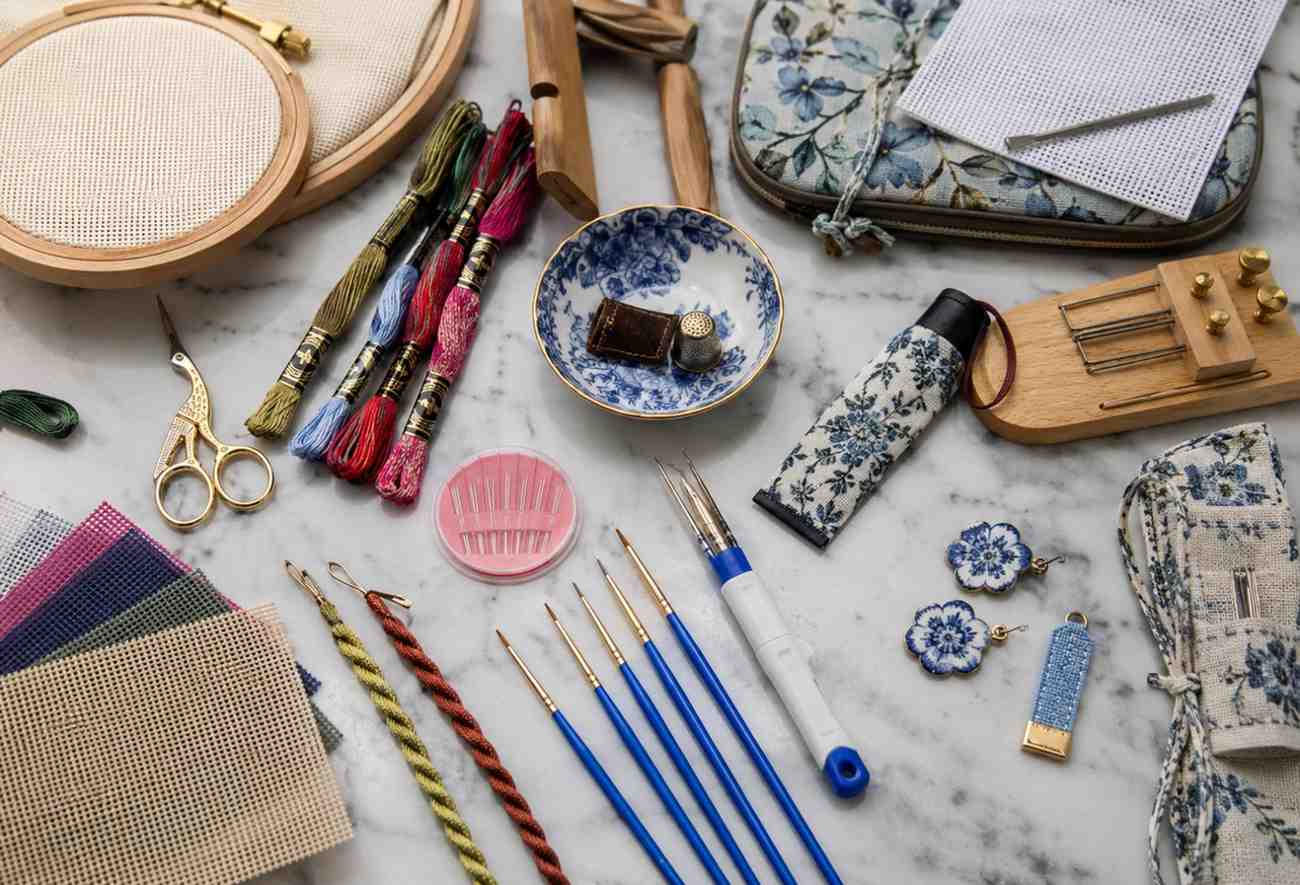
This one sounds simple, but a good pair of embroidery scissors is non-negotiable. You want something small, sharp, and precise, not your kitchen shears. Fine-tipped scissors let you cut thread close to the canvas without accidentally snipping adjacent stitches. Stork-style scissors are a popular choice because they're accurate and comfortable to hold during detailed work. Many stitchers treat their scissors as a bit of a prized possession, and honestly, that makes sense.
5. Stretcher Bars and Tacks
Keeping your canvas taut while you stitch is one of the most important things you can do to protect the quality of your final piece. Stretcher bars are wooden strips that you assemble into a frame and then lace or tack your canvas onto. Working on a properly stretched canvas reduces distortion, makes it easier to keep your tension even, and cuts down on the amount of blocking you'll need to do at the end. They come in a wide range of sizes and are reusable, which makes them a solid investment over time.
6. A Reliable Needle Threader
Threading a needle with silk or metallic thread can test anyone's patience, even experienced stitchers. A needle threader takes that frustration out of the equation. The small wire loop pulls your thread through the eye cleanly, and the better models are sturdy enough to handle heavier threads without bending out of shape after a few uses. Keep a couple on hand because they have a habit of disappearing at the worst moment.
7. A Laying Tool
A laying tool (sometimes called a trolley needle or a tekobari, depending on the style) is something many beginners overlook and then wonder how they lived without it. It's a smooth, pointed tool you use to guide your thread flat as you pull it through the canvas. This keeps your strands lying parallel and smooth rather than twisting over each other, which makes a huge difference in the finished appearance of your work. Once you start using one, the results are hard to ignore.
8. Thread Conditioner or Beeswax
Silk and metallic threads, in particular, benefit from being run through a thread conditioner before you stitch. Thread conditioner reduces tangling, static, and knotting, all of which can make stitching more frustrating than it needs to be. Beeswax is a classic, affordable option, and there are also synthetic conditioners available that work well for delicate threads like radiance needlepoint thread. A small block of conditioner lasts a surprisingly long time and is absolutely worth keeping in your kit.
9. A Needle Minder
A needle minder is a small magnetic accessory that holds your needle to your canvas when you're not actively stitching. This sounds like a luxury item, but anyone who has spent 20 minutes searching for a dropped needle on a carpeted floor will tell you it's not. They come in a huge variety of designs, florals, animals, quotes, seasonal themes, and many stitchers collect them as much as they use them. Emily's Stitchery carries a rotating selection of needle minders that make excellent gifts, too.
10. A Good Magnifying Lamp
If you stitch for more than an hour at a time, lighting matters more than you might think. A magnifying lamp gives you bright, directed light and some added magnification so you can see your canvas clearly without straining your eyes. This is especially helpful when you're working on a finely detailed design or a high-count canvas. LED models are the best choice in 2026; they run cool, last for years, and give you daylight-quality light that makes it much easier to see thread colors accurately.
11. A Sturdy Project Bag or Tote
Keeping your project organized and protected between stitching sessions is something that matters more than people expect. A good project bag keeps your canvas clean, your thread from tangling, and your scissors from puncturing anything important. Look for bags with multiple inner pockets and a firm base so your canvas doesn't get bent or creased. Many needlepoint-specific bags are designed with the hobby in mind and include compartments sized for thread, tools, and rolled canvases.
12. Masking Tape for Canvas Edges
This one's easy to overlook, but binding the edges of your canvas with masking tape before you start stitching prevents the canvas from fraying and keeps those rough edges from snagging your thread. It's cheap, it takes about two minutes to apply, and it saves a lot of headaches later. Painter's tape works just as well and tends to remove cleanly when you're done.
13. A Stitch Guide
A stitch guide is a document, printed or digital, that maps out exactly which stitches and thread colors to use where on a specific canvas. Many painted canvases don't come with one automatically, but purchasing a stitch guide created by a professional designer is one of the best ways to improve your skills and get a polished result. Emily's Stitchery offers stitch guides for many of the canvases they carry, and these are particularly useful for stitchers who are still building their confidence with decorative stitches.
14. Blocking Board and Rust-Proof Pins
When you finish stitching a canvas, it almost always needs blocking, a process where you wet the canvas and pin it into its correct shape while it dries. A blocking board (foam-core or dedicated needlepoint blocking board) and rust-proof T-pins are the tools you need for this. Using regular pins risks rust staining on your finished piece, so the rust-proof variety is essential. Proper blocking transforms a slightly warped, uneven piece into something that looks clean, professional, and ready to frame.
15. A Thread Storage and Organization System
The more you stitch, the more thread you accumulate, and if you don't have a system, you'll spend more time untangling than stitching. Thread cards, floss bobbins, and zippered bead or thread storage cases all help keep your collection manageable. Many stitchers organize by brand or color family, and having your threads visible and accessible makes it easier to plan your projects and avoid buying duplicates of colors you already have.
Where to Find the Best Needlepoint Accessories in 2026
Finding all of these products in one place used to require several different shops. Today, Emily's Stitchery brings together a carefully selected range of needlepoint accessories, including radiance needlepoint thread, stitch guides, needle minders, and seasonal canvas collections, making it a trusted go-to for stitchers across the country. Their Spring Needlepoint Market 2026 collection, in particular, is worth browsing if you're looking to refresh your supplies or try something new this season.
Final Thoughts
Needlepoint is one of those hobbies where the right tools genuinely change the experience. You don't need to buy everything on this list at once, but knowing what the best needlepoint accessories are, and why they matter, puts you in a much better position to build a kit that works for you. Whether you're treating yourself to radiance needlepoint thread for the first time or finally picking up a laying tool after years of stitching without one, each addition to your collection is a small step toward work you'll be proud of.
For a carefully selected range of the best needlepoint accessories available in 2026, explore the Spring Needlepoint Market collection at Emily's Stitchery, and find exactly what your next project needs.
Frequently Asked Questions
What are the most essential needlepoint accessories for a beginner?
If you're just starting out, the most important things to have are a good set of tapestry needles in a few sizes, a pair of sharp embroidery scissors, stretcher bars to keep your canvas taut, and a needle threader to save you frustration. Beyond that, a thread conditioner and masking tape for your canvas edges are small additions that make a big practical difference. You don't need everything at once; build your kit gradually as you figure out what your stitching style calls for.
What is radiance needlepoint thread, and why do stitchers like it?
Radiance needlepoint thread is a silk and metallic blend thread known for its smooth texture and subtle sheen. It's popular because it adds visual interest to a finished piece without being overly flashy, and it's easier to work with than many other metallic threads on the market. Emily's Stitchery stocks it in a wide range of colors, and it works especially well for accent areas, borders, and holiday designs.
How often should I replace my needlepoint accessories?
Most needlepoint accessories last a long time if you take care of them. Tapestry needles should be replaced when they start to feel rough or scratchy, which means the plating has worn off. Scissors should be sharpened or replaced when they start to crush rather than cut thread cleanly. Stretcher bars are reusable almost indefinitely. Thread conditioner and masking tape are consumables you'll replace regularly depending on how much you stitch.
Is Emily's Stitchery a good source for needlepoint accessories?
Yes, Emily's Stitchery is a well-regarded needlepoint retailer that carries a curated selection of accessories, threads (including radiance needlepoint thread), painted canvases, and stitch guides. Their Spring Needlepoint Market 2026 collection is a great place to explore new products and seasonal designs. They're known for quality curation and a strong understanding of what stitchers actually need.
Do I need expensive accessories to get good results in needlepoint?
Not necessarily. Some of the most useful accessories, masking tape, beeswax, and needle threaders, cost very little. That said, a few things are worth spending a bit more on: sharp scissors, good-quality thread like radiance needlepoint thread, and a proper blocking board will all have a visible impact on your finished work. The goal is to buy a few reliable tools rather than a lot of cheap ones that you'll end up replacing.